2022年10月25日
English
Japanese

MKP ENGINEERING LLC
Eye opening Engineering 《No.4》Good ‘ERIPA’ Co-Generation System
Good ‘ERIPA’ Co-Generation System
‘ERIPA’ is a new Japanese word which means good Area Performance.
Nowadays in Japan, people use new Japanese words such as ‘COSPA’ which
means good Cost Performance and ‘TAIPA’ which means good Time Performance. There is also a new Japanese word ‘SUPEPA’ which meansgood Space Performance.
But as for Co-generation system making Power and Heat, a word ‘Area’ is more suitable for it than a word ‘Space’.
【Comparison between Solar power generation and Co-generation】
Generally speaking, the advantage of Soler power generation is a contribution for environment of no CO2 emission into atmosphere, i.e., clean energy.
However, the following disadvantages are appointed recently.
- Risk of nature disaster: the possibility of land scape and overflood due to weakened ground by cutting down of forest and developed land.
- Bad influence for ecosystem and scenery.
- There is power transmission loss from power plant installed in rural area to power demand area.
- Power demand is not expected timely because of climate change.
The mean rate of operation efficiency is low as approximately 12 to 14%. - It is possible to accumulate the generation power into battery, but its investment cost becomes very expensive.
The area of solar power is necessary 1.5 to 2.5 ha for 1MW generation.
On the other hand, Co-generation influences badly environment by exhausting CO2emission into atmosphere because of using fossil fuel, but there are the following
advantages against solar power generation.
- Power can be supplied timely in accordance with the demand.
- By means of installation of Co-generation plant just near the area which is necessary of power and heat, there is low power transmission loss and effective operation of plant.
- The countermeasures against vibration, noise, environmental issue such as Nox and waste water are already established.
The general arrangement for many gas engines is attached. (*)
This plant consists of 28 set of 5.5MW and its area is about 1.8ha.
Comparing with the above mentioned soler power plant, its output is 150 times
under the same area size.
This means that Co-generation can be said good ‘ERIPA’.
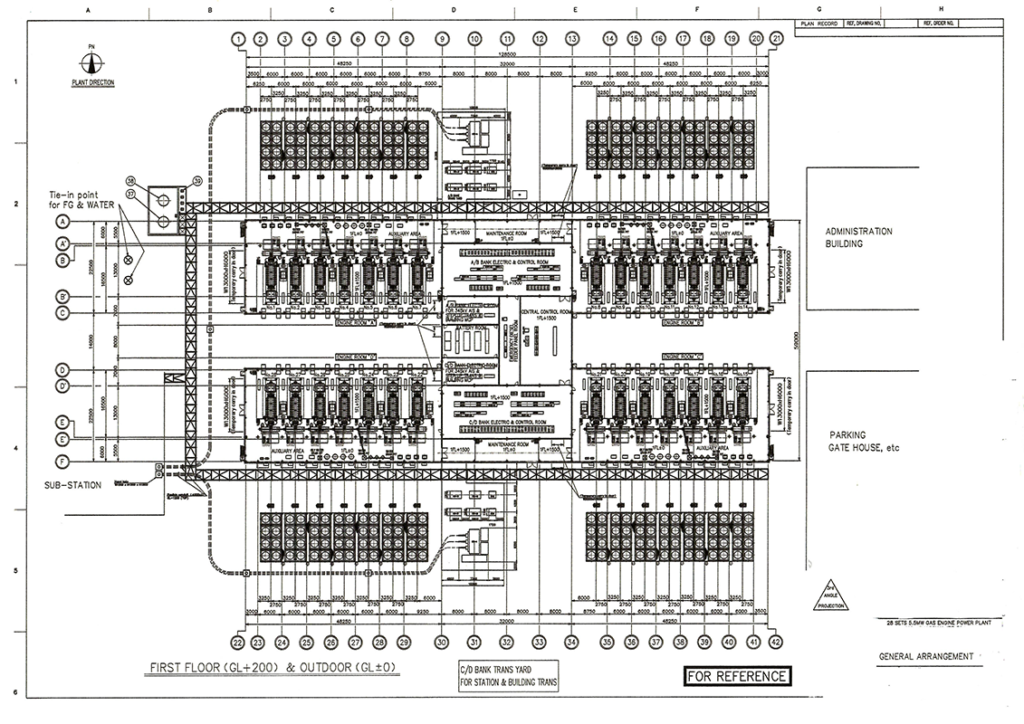
(*)This general arrangement is for the business just before being got an order, but this business could not be realized unfortunately.
Honestly speaking, the control room and electrical room is located in the center of arrangement and engines are installed in four directions, it can accomplish very effective operation. Very regrettable!
【Future prospective scenario of Co-generation】
Power generation with gas engine or gas turbine is estimated lower than renewable energy in environmental issue because of CO2 emission.
However, the following scenario is considerable.
- Hydrogen(H2) or Ammonia (NH3) is used as fuel besides LNG
Nowadays, the operation of gas engine or gas turbine with fuel of LNG mixing Hydrogen(H2) or Ammonia (NH3) up to 30% is confirmed.
In case single fuel firing of Hydrogen(H2) or Ammonia (NH3) with gas engine or gas turbine is attained, the above-mentioned estimation may be changed due to no CO2 emission.
There still remains necessary solutions for hydrogen embrittlement and ammonia resistance on the parts of gas engine and gas turbine. - It is possible to produce Synthetic Natural Gas (SNG) with Methanation method.
This SNG can be utilized in gas engine or gas turbine as same as LNG.
【Carbon Neutral CGS (Co-Generation System)】
I would like to propose a near future system combining the above-mentioned technologies as below.
- The main system is ordinary gas engine Co-generation using LNG.
It can be applied for gas turbine Co-generation. - Synthetic Natural Gas (SNG) is produced with Methanation method and is supplied to ordinary LNG line additionally.
- Hydrogen (H2) for Methanation is produced by NH3 cracking method that ammonia is imported from foreign countries so as for the advantage of good handling.
- Exhaust gas of gas engine is utilized for the cracking as heat because of high temperature as approx. 400℃.
- Carbon dioxide (CO2) for Methanation is extracted from exhaust gas of gas engine with CO2 separation & recovery technology.
- Steam and hot water generated by gas engine co-generation system is used for this CO2 separation & recovery technology of chemical absorption method.
- By means of installation above-mentioned technology facilities in the same area, there is no need of transportation for several gases (H2, CO2, CH4) and carbon neutral Co-generation system will be realized.
Initially operation is carried out with LNG, increasing additional Synthetic Natural Gas (SNG), finally carbon neutral Co-generation system with using ammonia will be attained.
Refer to the attached drawing titled as ‘CARBON NEUTRAL CGS (Co-Generation System)’.
This scheme will be patented in near future.